A web application is a system that runs through the browser and allows the user to interact, send data, and execute actions in real time. Understanding what a web application is and how it works is key to avoiding mistakes that can directly affect performance and business.
When someone decides to create a web application, they usually focus on features, design, or user experience. However, there is one part that is rarely considered at the beginning and ends up shaping the entire project: the infrastructure where that application will run.
Because a web application is not defined only by what it does, but by what it requires in order to respond when the user interacts.
What Is Really Happening Behind a Web Application
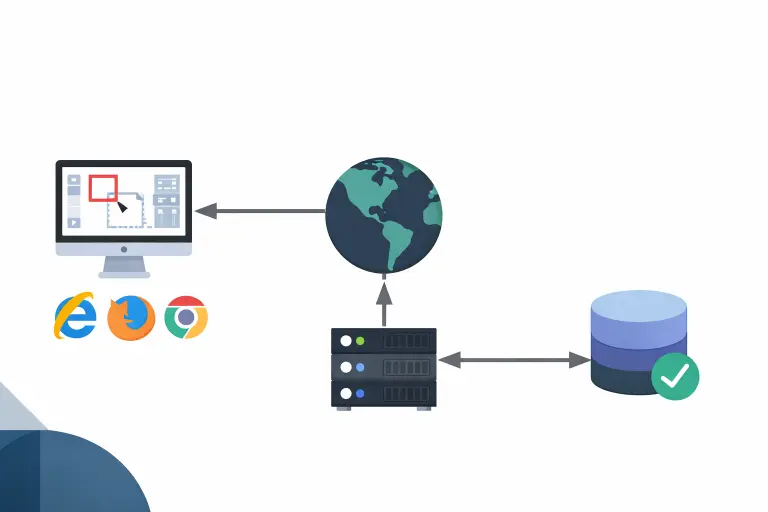
The difference between a traditional website and a web application is not visual. It lies in what happens behind the scenes.
While a website is limited to displaying content, a web application constantly manages processes. Every user action generates requests to the server, database queries, and executions that must be resolved in real time.
This has a direct implication: every click depends on the server.
If you want to explore the technical foundations of how these kinds of applications work, you can consult the documentation from Mozilla Developer Network.
If the server responds slowly, the experience breaks down. If it fails, the application stops existing for the user.
Real Examples of Web Applications
People often think that a web application is something complex or reserved for large companies, but the reality is different.
These are web applications:
- Gmail or Outlook Web
- Tools such as Trello or Notion
- The WordPress admin panel
- An eCommerce site with cart and payments
- An online booking system
- A private client area
In other words, any system where the user interacts and generates actions in real time.
This is important because many businesses already depend on web applications without being fully aware of it.
Web Application vs Website: Key Differences
Understanding this difference is essential if you want to avoid making the wrong decisions.
A traditional website:
- Displays information
- Has limited interaction
- Does not depend on complex processes
A web application:
- Allows continuous interaction
- Processes data in real time
- Depends on a database
- Requires immediate response
This is where everything changes.
Because while a website may tolerate a certain degree of slowness, a web application cannot. Every second of delay directly impacts the experience and conversion.
Why a Web Application Does Not Fail All at Once
One of the biggest mistakes is thinking these problems appear suddenly.
That is not how it works.
A web application degrades little by little:
- slower responses
- delayed processes
- intermittent errors
- a general feeling of instability
Until it reaches a point where the user stops trusting it.
And at that moment, you are no longer facing a technical problem. You are facing a business problem.
What a Web Application Needs to Work Properly
This is where projects that work are separated from those that create problems.
A web application needs:
- A stable and monitored server
- Low latency (fast response time)
- Enough resources (CPU and RAM)
- An optimized database
- A backup system
- Security against access issues and attacks
If any of these elements fail, the application begins to degrade.
The Role of Infrastructure (Where Everything Is Decided)
This is where most people get it wrong.
Infrastructure is not a technical detail. It is the foundation everything runs on.
It affects things such as:
- response time
- the ability to support simultaneous users
- system stability
- resource management
If this foundation is not right, any other improvement loses impact.
The Most Expensive Mistake
It is usually not in the development or the design.
It is this:
launching a web application on infrastructure that is not prepared to support it
It is a decision that does not create problems on day one, but becomes a limitation when the project starts to grow or depend on user interaction.
In fact, many of these problems come from not fully understanding what is being contracted from the start. If you want to avoid that, here is a complete guide on the most common mistakes when hiring hosting and how to avoid them.
What Kind of Environment a Web Application Needs
It is not about choosing “the best hosting,” but about understanding what your project needs at each stage.
A well-optimized shared environment may be enough at the beginning. But when there is real usage or the business depends on the application, you need resources, stability, and a foundation that responds without friction.
This is where many projects begin to notice the limits of what they have contracted, not because it is wrong, but because it was not designed to support constant interaction.
The Real Decision
Most people ask themselves the wrong question.
It is not whether you need a website or an application.
It is whether your project depends on user interaction.
If the answer is yes, infrastructure stops being a detail and becomes a critical part of the business.
Where the Real Difference Is Made
A web application is not measured by how it looks, but by how it responds when someone uses it.
And that response does not depend on design.
It depends on the foundation.
When infrastructure is well planned, the application simply works. Processes are smooth, responses are fast, and the user does not question anything. They just interact.
But when it is not, everything starts to fail little by little. And what looked like a technical problem ends up directly affecting the business.
That is why, when a web application starts to become truly important, leaving infrastructure in the background stops being an option.
This is the point where it makes sense to rely on solutions designed specifically for these kinds of projects, such as JC Hosting, where the priority is not just hosting a website, but making sure it responds when the user interacts.