Creating an easy web is probably one of the most common decisions when someone starts on the internet.
It makes perfect sense.
You don’t want to complicate things, you don’t want to depend on anyone and, above all, you don’t want to waste time on something technical that is not part of your business.
That’s why there are fast and easy solutions where building a website seems simple and accessible to anyone.
But there’s a part of the story that is not usually told:
The ease with which you create your website is often inversely proportional to its ability to grow, and that’s the point that changes everything.
The beginning of an easy website: why almost everyone starts this way
When someone wants to launch a website, they are usually in one of these situations:
- They have a business idea
- They want to validate something quickly
- They need an online presence as soon as possible
- They don’t have technical knowledge
In that context, it’s logical to look for a website that offers:
- Simplicity
- Speed
- Low initial cost
And this is where website builders fit perfectly.
Because they remove friction.
They allow you to go from 0 to 1 without thinking too much, but that step from 0 to 1 is not the problem.
The problem is what comes next.
What you are really building when you choose “easy”
When you choose a website builder, you are not just choosing a tool.
You are choosing:
- A closed environment
- A system with its own rules
- A limited structure
- An invisible ceiling
And this is important to understand from the beginning.
Because it’s not an aesthetic decision.
It’s a strategic decision.
Website builders: what they do well (and why they work)
Let’s be clear: they work.
And they work very well in the right context.
They allow you to:
- Create pages without code
- See changes in real time
- Publish quickly
- Have a “presentable” website in just a few hours
This solves the biggest initial problem: getting started
But it doesn’t solve the real problem: growing
The moment when “easy” becomes a problem
At the beginning, everything works fine.
Your website:
- Looks good
- Is online
- Can be shared
- Can even bring you some clients
But there comes a point where symptoms start to appear:
- You don’t show up on Google
- The website loads slower than expected
- You can’t implement certain optimizations
- The tools fall short
- You start depending too much on the system
And that’s when the initial decision starts to weigh on you.
Website performance: where money is lost without realizing it
One of the biggest differences between an “easy” website and a professional website lies in performance.
Website builders usually generate:
- Heavier code
- Less optimized structures
- Unnecessary resources
This directly affects:
- Loading speed
- User experience
- Conversion rate
And it also impacts SEO.
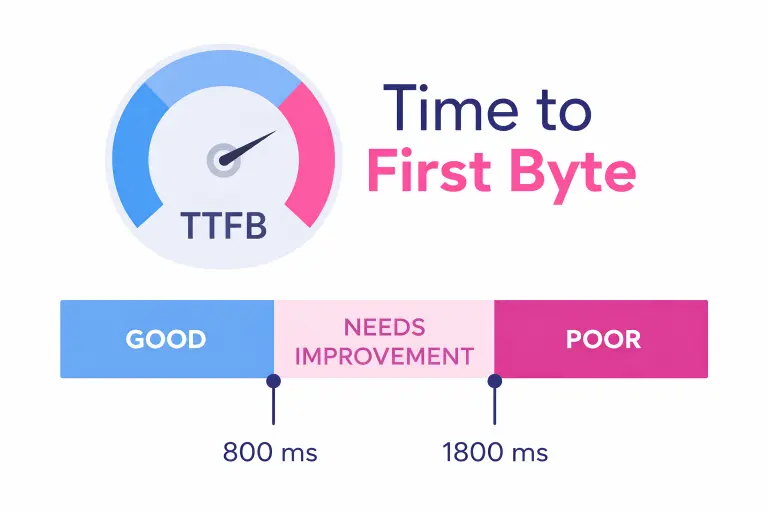
Google takes into account metrics such as Time to First Byte to evaluate how fast a website is.
Here you can learn more about TTFB.
If your server responds slowly, everything else loses effectiveness.
SEO: what you can tweak vs what really matters
Many website builders allow you to:
- Edit titles
- Add descriptions
- Change URLs
And with that, it seems enough.
But real SEO goes much further:
- Web architecture
- Internal linking structure
- Code optimization
- Performance
- Indexing control
This is where tools like WordPress offer a real advantage.
Not because they are more complex, but because they don’t limit you.
Dependency: the problem that appears when you want to leave
This is one of the most critical points.
When you build your web inside a builder:
- Your website depends on their system
- Your data is inside their environment
- Your options are conditioned
And when you decide to move: migration is not as easy as it seems
In many cases it means:
- Rebuilding the website
- Losing structure
- Losing rankings
- Investing time and money
Scaling a website is not adding content
Here’s another important mistake.
Scaling is not just:
- Writing more articles
- Adding more pages
Scaling means:
- Improving performance
- Optimizing processes
- Integrating tools
- Automating
- Converting better
And that requires a solid foundation.
Not a limited tool.
The real alternative: building it right from the start
This is where everything changes.
It’s not about making things harder.
It’s about not compromising your future for a quick decision.
The most solid combination today is:
- WordPress
- A professional hosting
Because it allows you to:
- Build easily
- Have full control
- Optimize at a technical level
- Scale without limits
Hosting: the piece that defines everything (even if no one looks at it)
Hosting is what supports your website.
It determines:
- Speed
- Stability
- Security
- Growth capacity
And it’s exactly where most mistakes are made.
If you want to understand this properly, here’s a key piece of content from JC Hosting:
What features should a professional web hosting for businesses have
There you’ll see exactly what you need to analyze before choosing where to host your website.
A website is not what you see, it’s how it works inside
Two webs can look the same.
But one can:
- Load in under one second
- Rank
- Convert
And the other:
- Be slow
- Not appear on Google
- Not generate results
The difference is not in the design.
It’s in the foundation.
When it does make sense to create an easy website
There are cases where it makes sense:
- Personal projects
- Quick tests
- No intention of ranking
- Ideas that are not yet validated
In those scenarios, simplicity is enough.
But if you are building a business…
You shouldn’t start with limitations.
The real mistake is not using a builder
The mistake is not knowing when to stop using it.
Many projects:
- Start with an easy solution
- Grow a little
- Get stuck
- And don’t understand why
And the answer lies in the foundation they chose at the beginning.
At JC Hosting we see it every day
At JC Hosting, we work with projects that reach that point:
- Easy website created
- Performance problems
- Technical limitations
- Need to migrate
And that’s where everything becomes clear: easy becomes expensive when you want to grow
That’s why our approach is different. We don’t sell “ease”.
We build foundations:
- Fast
- Stable
- Scalable
- Ready for business
And that doesn’t depend on the tool, it depends on the structure.